Graduation Address: Professor Derek Duncan, School of Modern Languages

Wednesday 3 December 2025 – afternoon ceremony
Vice-Chancellor, special guests, colleagues and graduates, it is a pleasure and an honour to congratulate all of you as you reach this moment of respite from the hard, but no doubt exhilarating, labour of your time at St Andrews.
The successful completion of a degree is a wonderful achievement, especially perhaps at a University like ours that is world leading in terms of research, teaching and learning and truly global in its ambitions, reach and composition of its staff and students. You have time now to look back of your success justifiably with pride. And thank all of those who helped you get to this point.
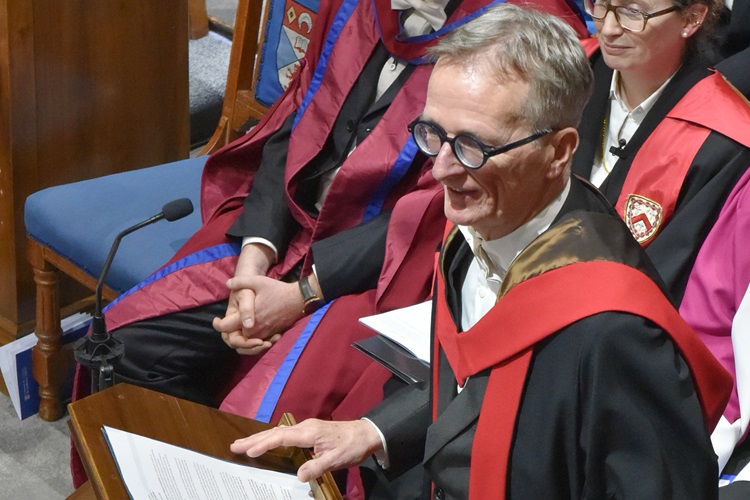
Coming from Modern Languages, I often wonder what the diversity of languages and cultures that come together in this small Fife town really adds up to? Does it make us instantly cosmopolitan, or does it require us to put time and effort into learning to hear and appreciate the different accents, voices, idioms and perspectives that feed into and, I would hope, transform, more than a little, the Anglosphere?
Learning a new language is hard. It is less a social accomplishment than an apprenticeship in failure – making mistakes, forgetting, misunderstanding – or simply not understanding at all. One of the great things about language learning is that it keeps us humble. On a positive note, the whole process is a reminder that we can never relax and stop learning. Not just learning things like verb endings, tenses and gender agreements but the other knowledges, points of view and ways of the world that are embedded in each language, and thanks to which we may gradually work out that things are not necessarily quite how we are used to seeing them.
Working with languages means always being aware that on some level we are struggling to make sense of the world and are always working in translation, shuttling back and forth between the new and the already familiar. The title of Eva Hoffman’s famous memoir about a young Polish girl finding her way in the United States by slowly and painfully acquiring what was an unfamiliar language is dystopian. Lost in Translation suggests bemused dispossession. The book’s subtitle ‘a life in a new language’ points to a more vital and cheerier outcome when languages and cultures meet. ‘Each language’, Hoffman says ‘modifies the other, crossbreeds with it, fertilises it’. Through language we grow.
‘I am,’ she concludes ‘the sum of my languages.’
Language is a precious but exhaustible resource. UNESCO claims that every two weeks we lose one of the world’s estimated 7,000 languages and, in consequence, the culture, traditions and knowledge embedded in it. We live in a time of great human mobility and a proximity to other languages and cultures is increasingly part of everyday experience. The ability to negotiate successfully this culturally diverse landscape requires that we too do not end up losing anything in translation.
We would hope then, to use Hoffman’s terms, that your time at St Andrews has given you the ‘fertiliser’ to move confidently across this precarious landscape, thinking and acting with flexibility and resilience to work towards humane, just and equitable solutions. The labour of translation reminds us that there are always other points of view, other words.
Maya Angelou, the American writer and civil rights activist, once described her mission in life as:
“…not merely to survive, but to thrive, and to do so with some passion, some compassion, some humor, and some style.”
You are about to leave St Andrews, and we do hope that you will return, and we also sincerely hope that, for whatever lies before you, you feel equipped to thrive with all the qualities that Maya Angelou so pithily lays out.
Warmest congratulations to you all once again.